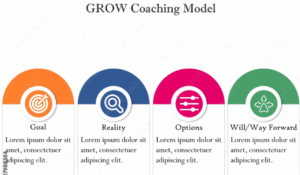
 The Grow Model
Goal:
The Goal section of GROW is addressed at the beginning of each session and referred to again from time to time to keep the focus moving forward, especially if the coachee becomes stuck. It raises energy and clarifies thinking. Identifying what we want to achieve puts us on the path to accomplishing it by focusing on the solution rather than the problem.
Some Goal questions are:
- What do you want? Or say your goal in a few words.
- Over what time frame? (3 months)
- Where would you like to be on a scale of 1–10?
- Imagine you have achieved it:
- What does it look like?
- How do you feel?
- What are people saying to you?
- What are the benefits? How does this success impact you in 5 years / 1 year etc
- Which part of that is the real focus?
- How will you know when you have achieved it? – measurable
- In an ideal world, what do you really want?
Reality:
This is an exploration of the coachee’s world at the moment. Time spent here helps people get clear about what is happening and how it affects themselves and others. It provides an opportunity for viewing issues from different perspectives.
Some useful questions here are:
- What is happening at the moment?
- How important is this to you?
- If an ideal situation is 10, what number are you at now?
- What impact is this having on you/how do you feel?
- What have you done so far?
- Who else is affected?
- What are you doing that’s working towards your goal?
- What are you doing that is getting in the way of your goal?
Reality questions (together with Goal questions, which can be thought of as ‘future reality’) enable coachees to step off the confusion track, gain some new perspectives, and make calm, informed decisions about how to move forward.
It may feel awkward at first to explore current reality, and new coaches are tempted to go straight to the Options or Actions stage of GROW. However, doing this without exploring the coachee’s Goal and Reality may well result in the answer ‘I don’t know what to do, that’s why I’m here!’.
All these questions help people dig deeper into their own awareness. They will show signs of energy, for instance, lightness in the voice, brighter eyes, a smile and more upright posture. That is the time to pin the new insights down to Options and Actions, and the chances are that by this time, coachees will spontaneously start originating actions where they were stuck before.
Note that we are exploring the present, and although we may ask what someone has done so far, we are not dwelling on the past or listening to stories about it. We are focusing on what the situation means to the coachee more than on the facts. We are not asking questions to find out what has happened, but to find out what impact it is having on the coachee’s work and/or life. When the coachee reaches a new insight or level of understanding, it is wise to explore the new Reality to embed the new awareness and to revisit the Goal. Possibly a new Goal or direction will emerge. Then the ‘Options’ and ‘Will’ sequence start again.
When the coachee reaches a new insight, these questions are useful:
- What do you know now that you did not know before?
- What is your insight about that?
- What have you learned about yourself from that?
- Where else could you use this?
Options
Coachees will move naturally towards the Options stage as their Reality becomes clearer. Often they show a new energy by sitting up and smiling, or a lighter tone of voice. Then it is useful to ask some of these questions:
- What are your options?
- What could you do?
- What else?
- If there were anything else, what would it be?
- What has worked in the past?
- What steps could you take?
- Who could help you with this?
- Where could you find out the information?
- What might someone else do in your shoes?
- Imagine you have achieved your goal; look back on the journey and tell me you got here.
Notice that most of these questions are almost all open. Keep asking open questions until the coachee has stopped coming up with options on the table. Once it seems that the list is complete, ask the closed question ‘is there anything else?’ to find out whether it is time to finalise the process. This question often results in new options and can be asked as many times as it continues to deliver results.
The following questions probe for more information and, in order not to commit the coaching sin of ‘leading’ the coachee, should be used only when the coachee has raised the subject in question, for example:
Coachee: I need some help.
Coach: Who could help you with this?
Coachee: I need more information.
Coach: Where could you find more information?
Will
As opposed to ‘Options’, which brings to light all possibilities, ‘Will’ is about discovering which actions the coachee can commit to undertaking. When asked, ‘What will you do about this?’ there is a danger that the coachee will make a list of what they think they should do, rather than choosing a pathway which suits their talents and ways of behaviour. The classic example is where a man commits to joining a gym because he wants to lose weight. However, if he is never going to attend because he hates going to the gym, he would get more benefit from committing to walk his dog every morning, if that is something he would enjoy.
Some examples of Will questions are:
- What will you do about that?
- How will you do that?
- When?
- What will it take for you to commit to that action?
- What could you do to become more committed?
- Could you do more?
- How many?
- How much?
- How often?
- Where will you find that?
- Who will you talk to?
- What else you could you do?
If the coach senses a lack of commitment, a question like, ‘How committed are you to doing that?’ should be asked straight away. If there is any hesitation, it is best to go back into the GROW process to clear any blocks and find the most comfortable way forward.
Flexibility of GROW model
It is crucial to understand that the components of GROW do not necessarily follow that order; an effective coaching conversation usually starts by exploring Goal and Reality, but then moves about between all four elements at will:
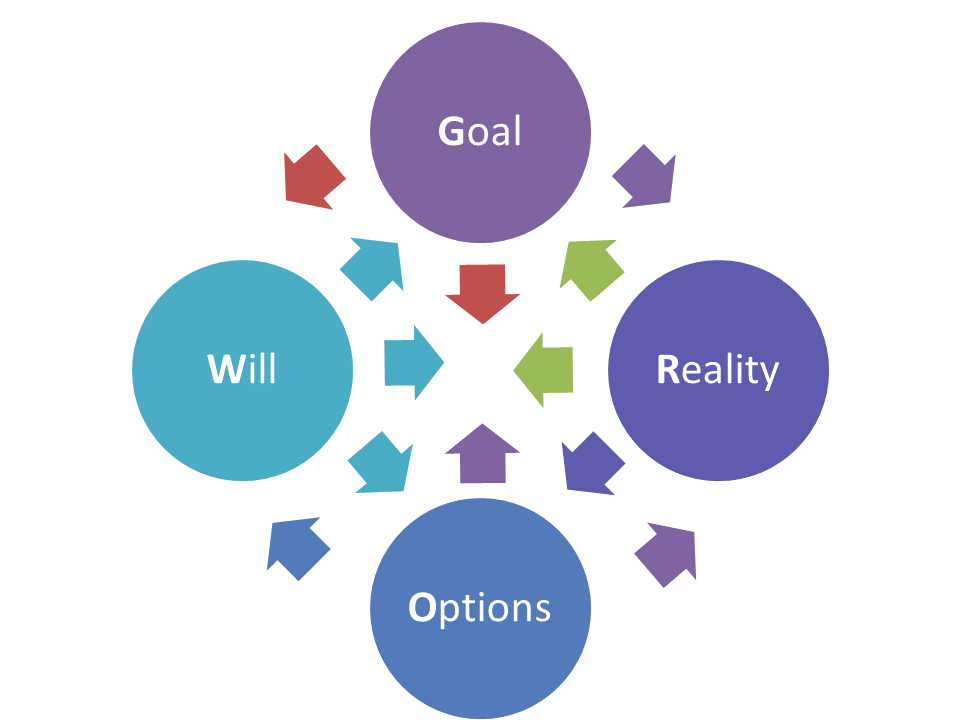
Since the GROW model was coined there has been some variation on the interpretation of the ‘W’. Sometimes it is given to stand for ‘wrap up’ or ‘way forward’, or ‘what actions will you take?’ Sir John Whitmore was unequivocal in his explanation to me that W stood for ‘will’ in the sense of having the will to commit, and that this interpretation is an important part of the model.
John was also concerned that people should not follow the model slavishly. It is merely a framework to provide an awareness of which type of question will be the most productive, in terms of future asp-ration, current reality or next steps. Where the coach’s question lies in this framework usually matters more than the question itself. Goal questions raise energy, Reality questions provide clarity, and Options and Actions questions turn ideas into achievements.
Credit to:
In the mid to late 1980s, Alan Fine, Graham Alexander, and Sir John Whitmore developed the GROW model, which is one of the most recognized and influential coaching models in the world.